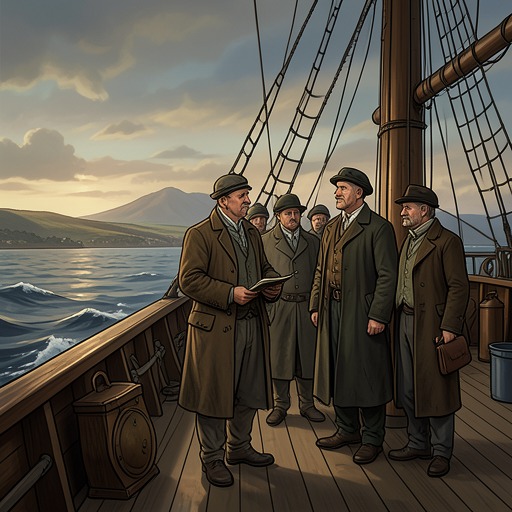
Fredrik Mattsson
The EmigrantsFredrik Mattsson is a passenger on the Charlotta whose nickname, “the American,” rests on a fiction: although he presents himself as a man of experience in the United States, he has never been there. His invented past makes him a comic impostor, but also a revealing figure in Robert’s inquiries into America and into the unstable difference between telling a lie and believing a story.
Identity and Introduction
The ship’s passengers call Fredrik Mattsson “the American” because he has never been to America—a joke whose meaning becomes clear only after Robert has taken his claims seriously. Fredrik’s bright checked jacket helps make him a conspicuous presence aboard the ship, where Robert repeatedly approaches him for information about the country they are sailing toward. At first, Fredrik presents his silence as a matter of patriotic duty: he claims that the President has forbidden him to disclose important secrets about the government. He says he has occupied positions that gave him access to those secrets, and that revealing them would prevent his return to the republic.
Fredrik’s supposed authority speaks directly to the emigrants’ circumstances. They have heard of a distant country through rumors and pictures, but none of them from their home communities has explored it. In that setting, a passenger claiming first-hand knowledge could appear to bridge the gap between the familiar life left behind and the unknown country ahead. Fredrik exploits that gap, while his tales also show how readily an imagined America can be made to sound like a remembered place.
Robert’s Questions and Fredrik’s Stories
Robert is particularly eager to learn about the United States, asking Fredrik about its government, soil, and climate. Fredrik repeatedly refuses to answer directly, invoking his alleged promise of secrecy to the American President. When Robert asks him to read aloud from an English textbook, Fredrik again puts him off, saying he has read English books for years and is tired of the language. He promises to read another time, but offers no reliable help with the practical questions that matter to the emigrants.
Instead, Fredrik supplies a striking account of his supposed employment on a ship on the Mississippi River. He describes the river as enormously broad and claims the vessel carried more than a hundred women. As their supervisor, he says, he was responsible for keeping order and carried two loaded pistols; he recounts having authority to shoot people in the legs to stop fights, with different limits for women and men. His story is presented as a responsible post, but its extravagant details deepen the suspicion surrounding his claims rather than confirming his expertise.
Robert eventually learns the truth from the old sailmaker, who says that he and Fredrik were born in the same parish, Asarum, in Blekinge, and that he has known him since infancy. The sailmaker describes Fredrik as a habitual liar and a man who had left serious trouble behind: three women were pregnant by him at the same time, he owed money widely, and more than one person had reason to beat him. He says Fredrik had never been to sea before boarding the Charlotta and had not even left his home parish. Fredrik is therefore not a returned emigrant or seasoned traveler, but a local man escaping his circumstances by joining the voyage.
Robert’s Judgment and the Problem of Truth
The discovery disappoints Robert, who realizes that he is nearly the last passenger aboard to learn why Fredrik is called “the American.” He no longer trusts Fredrik’s accounts of the United States. Yet the novel does not leave the matter as a simple contrast between the liar and the honest observer. Robert recognizes that he, too, sometimes mixes invention into a tale when he cannot continue from what he has read or experienced; afterward, truth and fabrication can become difficult to separate in his own telling.
That self-recognition complicates Robert’s judgment. He considers the possibility that Fredrik may have repeated his invented American experiences until he believed them himself, so that his stories no longer felt like lies to him. The thought does not establish that Fredrik’s claims are true; the sailmaker’s account decisively contradicts them. Instead, it shows Robert testing the nature of falsehood against his own habits of storytelling and wondering why people may find invention useful. Fredrik’s alleged past becomes a mirror for Robert’s awareness that narrative can carry its own momentum, blurring the speaker’s distinction between experience and imagination.
Narrative Role and Significance
Fredrik’s deception unfolds within the emigrants’ passage, where practical arrangements and uncertain knowledge coexist. The Charlotta is a merchant brig bound directly from Karlshamn to New York, carrying pig iron and other goods as well as emigrants. Its passengers face tightly crowded quarters, shared provisions, rationed fresh water, and rules they must follow during a long crossing. Against this concrete shipboard world, Fredrik’s grand claims offer a counterfeit kind of passage: he supplies stories of a country he has never reached, just as the emigrants are physically moving toward one they know mainly through reports and hopes.
The exposure of Fredrik’s past does not erase the imaginative force of his stories. Rather, the episode distinguishes the migrants’ collective movement from the unreliable tales attached to their destination, while acknowledging that Robert himself is not wholly outside the process by which stories are made. Fredrik is at once a deceiver fleeing debts and entanglements, a source of misleading information, and a figure through whom the novel examines how an unknown land can be populated in advance by invention. His nickname thus carries a double meaning: it marks the gap between who he is and whom he pretends to be, and recalls the emigrants’ own uncertain knowledge of the America toward which they sail.